

In today’s article, historian and author David O. Stewart explains, “US President Donald Trump’s relentless pursuit of media attention at the 2026 World Cup highlights the dangerous symbiosis between politics and sports. This trend echoes historical flashpoints, such as author George Orwell’s 1945 clash with Olympian and Nobel Prize winner Philip Noel-Baker over a Soviet soccer tour. While Orwell saw competition as war without shooting, figures like Trump and Noel-Baker embraced its potential to foster unity — or headlines.”
Scroll down to read the entire article, and click here to more features in Fair Observer: FairObserver.com.
Sport and Politics: Strange Bedfellows or Friendly Ones?
Attracted, mothlike, to the bright lights of media attention at an event that was not about him, US President Donald Trump feverishly sought the soccer spotlight during the summer’s World Cup spectacle in North America. His pursuit of publicity recalled the truism that the most dangerous place to stand at a public event is between a politician and television cameras.
Trump’s World Cup spotlight
The full-on Trump-a-thon began months before a single man in short pants began kicking a round ball on vibrantly green playing fields. Last December, the World Cup’s sponsor, FIFA, convened a public ceremony at the Washington, DC arts venue then named the Trump-Kennedy Center (now stripped of the first name by court order). FIFA’s senior leader presented to Trump the first ever “FIFA peace prize,” a baffling lurch into international diplomacy by a sporting association. Can the National Football League poetry awards be far behind?
Then came the president’s decision to intercede with his FIFA pal to reverse the suspension of American striker Folarin Balogun, the first reversal of a World Cup suspension in 64years.
The president’s final lunge for the spotlight came after the final match in Philadelphia, when it was time to crown the Spanish team the victors. After enduring a chorus of lusty booing, catcalls and whistling, Trump loitered awkwardly on the awards platform, plainly unwilling to leave the epicenter of attention. Finally, FIFA chief Gianni Infantino hustled out onstage to coax him off the platform.
When sports become presidential politics
This mingling of sports and politics was hardly unprecedented, but has rarely been pursued with such urgency. When he was first elected president, Trump leaped into a public controversy in 2017 when quarterback Colin Kaepernick of the San Francisco 49ers protested police brutality by declining to stand during the national anthem at the beginning of football games. The president denouncedKaepernick on his then-Twitter account and took credit for the team’s decision to dismiss the quarterback.
For more than a century, US presidents enjoyed throwing out the first pitch at Major League Baseball games — often at All-Star games or World Series contests, or on the season’s Opening Day in years when Washington had an actual major league team. It began with William Howard Taft in 1910 and continued through Woodrow Wilson, Franklin Roosevelt (a record-setting 11 first pitches as president), and both George H.W. Bush and George W. Bush.
Presidential performance of the chore has varied in skill level. Among more recent chief executives, lefty Bill Clinton and George W. Bush each hummed their pitches home, while lefty Barack Obama and George H.W. Bush tossed embarrassing one-hoppers. Our two most recent presidents — Trump and Joe Biden — never threw out a first pitch while in office, perhaps a concession to their ages when they took office.
In 1972, then-President Richard Nixon, facing a re-election contest in the coming November, telephoned Miami Dolphins coach Don Shula before the Super Bowl. The president, who had been a third-string lineman on his college football team, recommended that the Florida-based team run a “down-and-in” pass play to star receiver Paul Warfield. The presidential advice did not help. Miami lost, 24–3.
Orwell vs. Noel-Baker: a literary clash over the politics of sport
Few episodes at the intersection of sport and politics, however, have had the literary sizzle of a British quarrel in late 1945 over a “goodwill” tour of Britain by a leading soccer team from the Soviet Union, Dynamo Moscow. Through World War II, the two nations had been wary allies. The Soviets still resented British intervention against the Bolshevik Revolution of 1917, while British Prime Minister Winston Churchill’s government deeply mistrusted Soviet intentions. Perhaps the thinking was that a postwar soccer tour would soften hard feelings.
Author George Orwell (nom de plume of Eric Blair) was appalled at the prospect. Already well-known for several books (Animal Farm, Homage to Catalonia, The Road to Wigan Pier) but not yet as famous as he would become for writing 1984, Orwell denounced the tour. His view was soon firmly rejected by Philip Noel-Baker, the only person in history to win the Nobel Peace Prize and an Olympic medal. Noel-Baker was a literary figure of lesser brightness, having written several books addressing military disarmament and praising the League of Nations.
In late 1945, Noel-Baker held office as Minister of State for Foreign Affairs. In addition to his Olympic credentials, he knew soccer (“football” in Britain), having led the 1906 Haverford College team to the US collegiate championship as its leading scorer.
Orwell began the fireworks with a newspaper blast lamenting the Moscow team’s tour and sneering at the tour’s sponsors “blah-blahing about the clean, healthy rivalry of the football field and the great part played by the Olympic Games in bringing nations together.” For Orwell, the Dynamo tour simply encouraged young men to “kick each other on the shins amid the roars of infuriated spectators.”
Orwell lamented the “vicious passions that football provokes.” International sporting contests, he added, “lead to orgies of hatred,” fostering national delusions that “running, jumping and kicking a ball are tests of national virtue.” It was, Orwell insisted, merely “war minus the shooting.”
A believer in the healing power of sport, Noel-Baker had pressed his government to support the invitation for Dynamo’s Brittain tour. He swiftly rose to defend the move against Orwell’s attack. Noel-Baker well understood the political overtones of sport. In 1920, he won his silver medal at the Antwerp Olympiad, which excluded athletes from those nations on the losing side of World War I. In 1936, he initially called for a boycott of the Berlin Olympics as a protest against German Dictator Adolf Hitler’s Nazi regime (though he reversed that view).
Orwell, Noel-Baker insisted, was attacking sporting contests that could break down barriers between nations and peoples. “Is it so fantastic to believe,” he asked in an answering article, “that the provision of a sane intercourse and a sane rivalry of nations will help in breaking up the absurd fabric of ‘routine thinking’ on which the present system of international relations rests?” The revenues from the contests would be earmarked for the rebuilding of Stalingrad, devastated in the recent war.
Before leaving Moscow, the Dynamo players attended a meeting with dictator Joseph Stalin and Lavrenti Beria, head of the Soviet secret police and patron of Dynamo. The officials instructed the players that they could not lose to British capitalists. Not exactly buoyed by that threatening message, the Dynamos were dismayed by their initial London lodgings in leftover wartime barracks whose beds lacked sheets or pillows. Better accommodations were soon arranged.
The enduring power of sport
Despite Orwell’s hostile views, more than a quarter of a million British fans attended Dynamo’s four soccer matches. In Fulham in southwest London, fans scaled the stadium’s outside wall to sneak inside. Local fans snickered when the Soviets presented bouquets of flowers in pregame warm-ups, a Russian practice unfamiliar to Britons.
Accustomed to thinking of English soccer as the best in the world, the fans nevertheless remained cheerful when the first match ended in a 3–3 tie, and even carried some of the Moscow players off the field on their shoulders. The next match in Cardiff honored the Welsh coal industry, with each Russian receiving a miner’s lamp. Welsh fans, however, were unprepared for the 10–1 drubbing endured by their heroes. A third match against traditional powerhouse Arsenal was shrouded with pea-soup fog and riven with officiating disputes. The Soviets prevailed again, 4–3. The finale in Glasgow brought another tie, 2–2.
After the tour’s end, and without an obvious change in Anglo-Soviet relations, Orwell’s words remained. Sport, he had insisted, “Is an unfailing cause of ill-will”:
Serious sport has nothing to do with fair play. It is bound up with hatred, jealousy, boastfulness, disregard of all rules and sadistic pleasure in witnessing violence.
Orwell had urged British footballers not to “follow up the visit of the Dynamos by sending a British team to the U.S.S.R,” Defying his wish, British teams played in Moscow in 1954 and 1955, while Dynamo returned to Britain in 1955 and many times after.
Noel-Baker was equally unpersuaded. He went on to serve as the government’s coordinator for the 1948 London Olympics, often referred to as the “Austerity Olympics” because wartime rationing of food and fuel continued three years after the war’s end. At those games, eighty thousand fans packed Wembley Stadium on four separate days to watch more competitors from more countries than the 1936 Berlin Games had attracted. After the contests closed, Noel-Baker defiantly insisted:
The [Olympic] Games are not some faked antique – they answer something universal and eternal in the human heart, something which very visibly had touched the athletes and nations of the world.
For the rhetorical match between the two writers, Orwell won on style points for his arresting metaphors and entertaining word choices. Grading on the basis of worldview, however, Noel-Baker gave voice to a sunnier attitude embraced by a far wider part of the public. For President Trump, the World Cup certainly touched “something universal and eternal in the human heart,” but unfortunately it was his unquenchable lust for attention.
[Kaitlyn Diana edited this piece.]
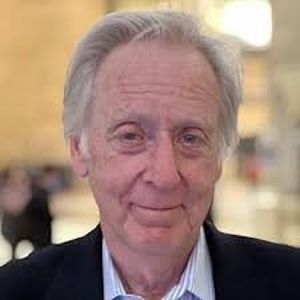
Author and historian David O. Stewart
Meet David O. Stewart: A trial and appellate lawyer for many years, David writes history and historical novels. He has received the Lifetime Achievement Award from the Washington Independent Review of Books, was a reporter for the Staten Island Advance, and for 10 years wrote the monthly Supreme Court column for the American Bar Association Journal. He has also done on-air commentary for CNN, C-SPAN, Bloomberg News, and MSNBC.
About his newest book, The Democracy We Must Keep:
What did America’s founders say about democracy—and can we remain true to their vision for America? Two hundred fifty years ago, passionate men attempted to create something the world had never seen before: a nation built not on kings or armies, but on ideas where the people ruled. In The Democracy We Must Keep, historian David O. Stewart takes readers inside the nine key documents that shaped the formation of the United States—from Patrick Henry’s thunderous cry for liberty to the carefully crafted design of a government chosen by the people, with limits on all officials holding power under the Constitution.
Through the words of seven visionary founders—Washington, Jefferson, Madison, Hamilton, Gouverneur Morris, and others—Stewart shows how a fragile experiment in self-government took shape. These men were not saints. They argued passionately. They worried that the new nation might fall apart. Yet together, they forged the principles that must still define American democracy: That power must be limited. That leaders must answer to the people. That individual rights must be protected by law.
As the United States celebrates its 250th anniversary, The Democracy We Must Keep urges readers to rediscover core ideas that built the nation—and to consider what it will take to protect them. Accessible, engaging, and timely, this book is for anyone who wants to understand how American democracy started, and why it still matters. Learn more: davidostewart.com • Click here to buy David’s books