
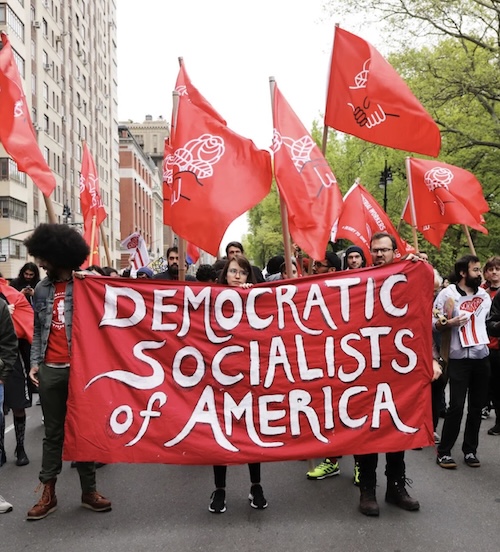
Check out this week’s blog post by IP attorney and author Timothy Trainer, host of the podcast and video show Tim’s Travails • Follow Tim on Substack
Image source: Britannica.com
Democrat, Republican, liberal, conservative, socialist, communist, anarchist, libertarian, fascist, environmentalist. You see these words, these political labels, and react to them positively or negatively. Democratic Party primary election victories by unexpected winners have resulted in the surge of labeling some of these winners as “democratic socialists”. Of course, it sounds like it’s coming out of left field because most people, including those who are attempting to attach something negative to the label, probably don’t know what the label means or identifies. Has anyone read the loose and somewhat convoluted definition of what “democratic socialist” means? Democratic socialism | Definition, Leftists, Social Democrats, Zohran Mamdani, & Facts | Britannica.
Suddenly, Republican/GOP members are trying to paint these unexpected Democratic Party victors as “communists”, a word that will get many voters’ blood boiling. Common sense should give us a hint that if socialist and communist were the same thing there would be no need for two distinct words. Ironically, democratic socialism as explained by Britannica “reject Marxism-Leninism (i.e., communism) as a form of socialism” for an economy as massive as the U.S.
The GOP labelling tactic is a scare tactic. We don’t like “communism” when it’s in the U.S., but we don’t mind it and we’re happy to overlook it when it pads corporate ledgers or helps the U.S. in trade dealings. There is a clear indicator that labeling a person a “communist” is nothing more than a scare tactic. Nothing says “manipulate” voters by labelling someone a “communist” more than looking at our Number 1 trading partner outside of North America. Recent trade data places China in this position: census.gov. China’s ruling political party is the Chinese Communist Party. Essentially, if one removes our neighbors, Canada and Mexico, from the list of our global trading partners China is Number One.
A glance at that government data underscores just how much we embrace communist economies as non-threatening when it comes to our trade relationship. Overall, Vietnam is our fifth largest trading partner, third largest when our Canadian and Mexican neighbors are removed from the list. For the sake of clarity, we recognize and embrace trade with Vietnam, a country ruled by the Communist Party of Vietnam. https://vietnam.gov.vn/ political-system-68959.
We can count on political labels being thrown around to try and paint someone as threatening to the U.S. It is much better, however, to look deeper at the person using some of these labels and ask the question: what does the person using these labels stand for? Political labels are easy to throw around but when there’s no context to their use, when there’s no thinking about what these labels mean, they become a tool for manipulation. Political labels are used to evoke an emotional response, not to provoke critical thinking.
Here’s a reminder. For decades, the GOP was the supposed party of fiscal restraint and, yet, the GOP has, without hesitation, ballooned the national debt with no qualms and no indication of slowing the growth of that debt. The current majority party has done nothing to prevent the imposition of tariffs and raising consumer prices that cause average citizens to suffer from higher prices.
For decades, the GOP campaigned on the theme of law and order whereas we now have the most anti-law and order administration ever as it is the Executive Branch itself violating the fundamental rights of the people within the United States on a daily basis and has been chastised by numerous federal court judges for violating the rights guaranteed in the U.S. Constitution.
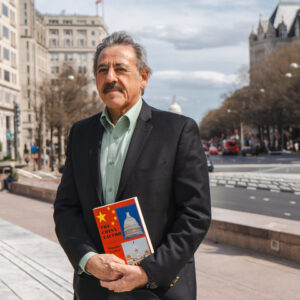
Timothy Trainer • Photo by AnnaGibbs.com
About Timothy Trainer: Writing books is a passion for attorney Timothy Trainer, who for more than three decades focused on intellectual property issues in his day job. He has worked in government agencies and in the private sector, and his assignments have taken him to 60 countries around the world.
Tim found time to pen a few non-fiction tomes, including his first book, Customs Enforcement of Intellectual Property Rights;the 15th edition was published in 2022. Thomson Reuters’ Aspatore Books published Tim’s next title in 2015, Potato Chips to Computer Chips: The War on Fake Stuff.
Fiction was a genre he always wanted to try. In 2019, Pendulum Over the Pacific, was released by Joshua Tree Publishing. “This political intrigue story is set in Tokyo and Washington, D.C., and centers on trade tensions between the U.S. and Japan in the late 1980s,” Tim explains.
In 2023, his first series hit bookstores: The China Connection.
In 2025, he published the sequel, The China Factor, which ranked #63 on the Amazon Asian Literature list in May.